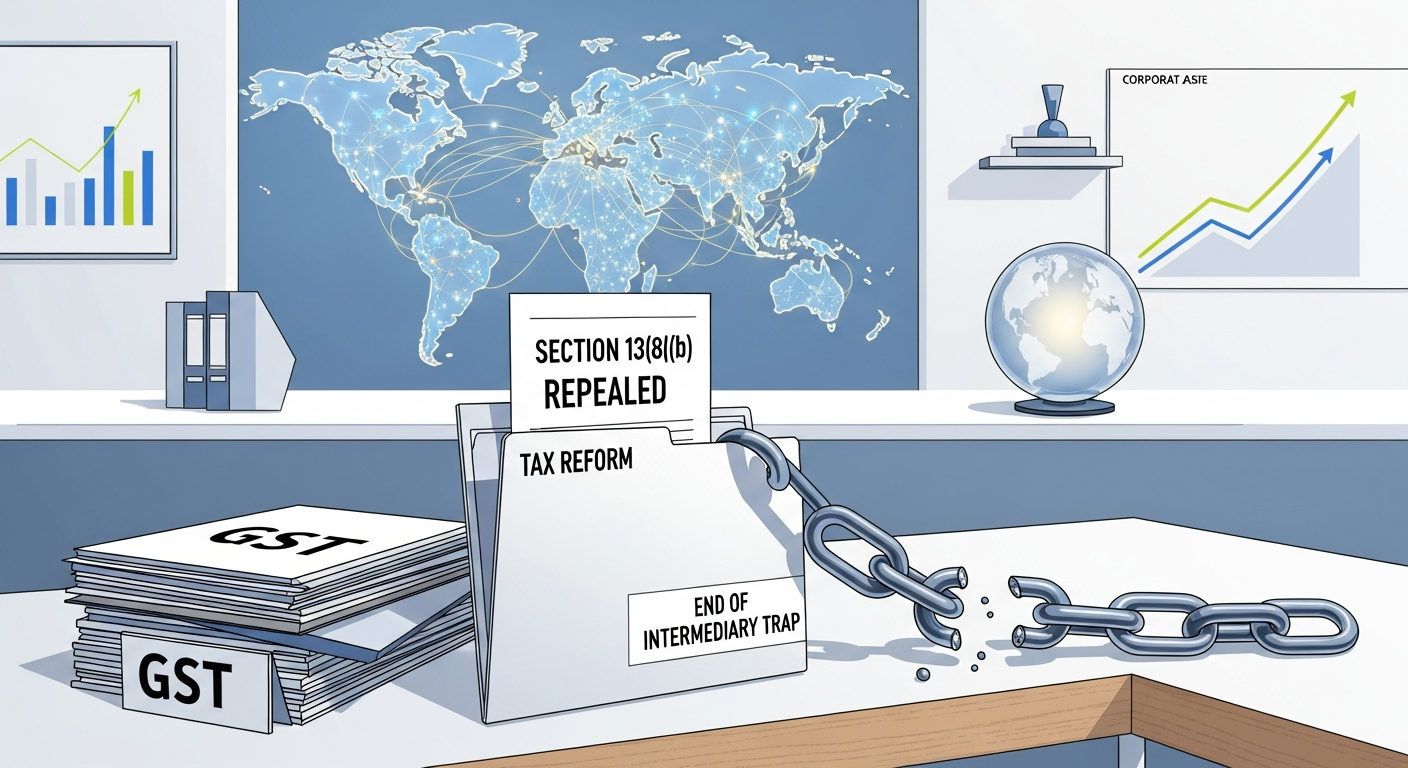
For nearly a decade, a single provision in India’s GST law created a structural tax disadvantage that no amount of careful structuring or aggressive litigation could reliably resolve. Indian IT companies, GCCs, BPO units, and service exporters were caught in a classification trap -paying GST on services that were, by any economic measure, consumed entirely outside India.
The Finance Act 2026, which received Presidential assent on 30 March 2026, has changed that. The omission of Section 13(8)(b) of the IGST Act is not a minor technical correction. It is a fundamental realignment of India’s GST framework with the principle on which the entire law was supposed to be built: that GST is a destination-based tax. For India’s services export sector, the implications are substantial.
The Old Problem -What Was Section 13(8)(b)?
GST is, at its core, a destination-based tax. Consumption is taxed where it occurs, not where the supplier is located. This principle governed the entire architecture of the IGST Act -except, until now, for one category of services.
Section 13(8)(b) of the IGST Act carved out a specific exception for “intermediary services.” Where the supplier and recipient of a service are located in different countries, the default rule under Section 13(2) places the supply at the recipient’s location. Section 13(8)(b) overrode that default for intermediaries: it deemed the place of supply to be the “location of the supplier” -India.
The practical effect was severe. An Indian company providing intermediary services to a client in the US, the UK, or Singapore -receiving payment in foreign exchange -could not treat that supply as an export. It did not qualify as a zero-rated supply under Section 16 of the IGST Act. GST was payable. Input tax credit accumulated but could not be refunded. Working capital was locked.
India’s GCC sector alone -over 1,700 centres employing 1.9 million professionals and generating $64.6 billion in revenue as of FY24, per government data -lived under the shadow of this provision for years. For an industry of this scale, the cash flow and compliance costs were not theoretical. They were real and recurring.
Who Was Caught in the Trap?
The ambiguity was not confined to a narrow slice of the market. It spread across virtually every service model where an Indian entity facilitated business between an overseas parent or client and an end customer.
Consider the following scenarios, each of which faced genuine risk of being classified as an “intermediary”:
- An “Indian subsidiary acting as the marketing and sales support arm” of a US-headquartered technology company -generating leads, managing relationships, and facilitating contracts between the parent and Indian or regional customers.
- A “BPO or KPO unit” processing transactions, handling customer data, or managing back-office workflows for an overseas principal -where the end beneficiary of the transaction was the principal’s client, not the Indian entity’s own customer.
- An “IT company providing technical helpdesk and support services” for an overseas software product -where the support function was arguably facilitating the principal’s supply to end users, rather than supplying independently.
- A “shared services or procurement centre” for a multinational group -performing functions that, on a close reading, could be characterised as facilitating the group’s supply chains rather than acting on its own account.
Tax authorities drew a hard line: any arrangement where a third party was involved, and where the Indian entity was not clearly supplying the service on its own account, risked reclassification as an intermediary.
The DGGI investigation that commenced in May 2025 brought this risk into sharp focus. Tax officials at both state and central levels, along with the Directorate General of GST Intelligence, launched investigations across Bengaluru, Haryana, Maharashtra, Chennai, Pune, and the NCR. Summons and notices were issued to GCCs and Indian subsidiaries of MNCs, questioning whether services -spanning backend technology, content development, marketing, design, and R&D -qualified as exports or fell within the taxable intermediary category. The ambiguity created not just tax costs but active litigation risk and measurable investor uncertainty.
The Legal Turning Point
The resolution came in stages, each one building toward the legislative outcome that arrived on 30 March 2026.
The default rule under Section 13(2) of the IGST Act now applies to intermediary services: the place of supply is the location of the recipient. The definition of “intermediary” in Section 2(13) of the IGST Act remains intact. The classification question -whether a given arrangement constitutes intermediary services -has not been resolved. But the consequence of that classification has changed entirely.
What This Means for Exporters
The shift in place of supply is not a formality. It fundamentally changes the tax treatment of services that were previously stuck in a domestic tax net.
Before 30 March 2026
Services classified as intermediary services supplied to a foreign recipient → place of supply was India → supply was not an export → GST was payable → no zero-rating, no ITC refund available.
After 30 March 2026
Place of supply is the location of the foreign recipient → if the conditions under Section 2(6) of the IGST Act are satisfied (services supplied to a person outside India, payment received in foreign exchange, etc.) → the supply qualifies as an export of services → zero-rated under Section 16 of the IGST Act → either supply under a Letter of Undertaking (LUT) with no GST payment, or supply with IGST payment followed by a refund claim which is available under Section 54(3), CGST Act. Eases working capital impact.
The sectors that stand to benefit most directly include IT and ITES companies, GCCs, BPO and KPO units, marketing and sales support entities, procurement and shared services centres, and professional consultancy firms operating within MNC group structures.
For many companies, the practical gain is immediate: accumulated ITC that could not previously be monetised may now form the basis of refund claims. Pricing structures that embedded a GST cost as a permanent drag can be revisited.
The Other Side -New RCM Obligation for Importers of Intermediary Services
The same amendment that benefits Indian service exporters creates a new compliance obligation for Indian businesses that receive intermediary services from overseas providers.
Before / After Effect
Before 30 March 2026: When an Indian company received intermediary services from a foreign vendor -say, an overseas booking agent managing hotel reservations, or a foreign securities broker facilitating transactions - the place of supply under Section 13(8)(b) was outside India (the foreign supplier’s location). This meant the arrangement did not constitute an “import of services” under Section 2(11) of the IGST Act, and no Reverse Charge Mechanism (RCM) liability arose.
After 30 March 2026: The place of supply defaults to the location of the recipient -India. The arrangement now satisfies the definition of “import of services” under Section 2(11). RCM is triggered under Sections 5(3) and 5(4) of the IGST Act.
The sectors most directly affected include hotels and hospitality businesses using overseas booking platforms, airlines using foreign travel agents, financial services firms using foreign securities brokers, and petroleum entities with overseas procurement intermediaries.
For businesses with full ITC eligibility, the economic cost of RCM is broadly neutral - the tax paid is creditable. The obligation is primarily one of compliance: self-assessment of the RCM liability, timely payment, and accurate documentation and reporting in GSTR-3B. For businesses with partial or no ITC eligibility, the RCM becomes a real cost.
This is not an oversight in the legislation -it is the logical consequence of applying consistent place-of-supply principles in both directions. But it requires immediate attention from affected businesses that have not previously had an RCM obligation on these procurements.
Immediate Action Checklist
The effective date of the amendment is 30 March 2026. Action is required now.
- 1Execute or renew your Letter of Undertaking (LUT) for FY 2026-27. Supplies that now qualify as zero-rated exports should be made under a valid LUT to avoid payment of IGST. File on the GST portal before making the first zero-rated supply.
- 2Review accumulated ITC balances. If your business has been paying GST on services supplied to overseas clients that should now qualify as exports, you may have accumulated input tax credit. Assess your eligibility to file refund claims under Section 54(3) of the CGST Act.
- 3Identify all inbound foreign intermediary arrangements. Map every service your business receives from overseas intermediary service providers. Assess whether those arrangements now trigger an RCM liability and ensure compliance from 30 March 2026.
- 4Review contracts with overseas principals and clients. Examine pricing, invoicing, and GST clauses. Arrangements that previously included embedded GST costs may need to be repriced or restated. Contracts that described services in terms that assumed domestic taxability should be revisited.
- 5Re-examine your invoicing structure and service classification. Services previously classified as taxable intermediary supplies may now be zero-rated. Update your tax codes, invoice templates, and ERP configurations accordingly.
- 6Consult your tax advisor on protective refund claims and pending proceedings.
The amendment is prospective. Past assessments, demands, and litigation are not automatically resolved. A structured approach to historical exposure -including protective refund filings and engagement with pending DGGI proceedings -is advisable before year-end.
Remaining Ambiguities to Watch
The omission of Section 13(8)(b) is significant, but it does not resolve all questions.
Prospectivity
The amendment is effective from 30 March 2026. Past tax demands, refund denials, and pending litigation for periods prior to that date will need to be addressed separately. There is no savings clause or retrospective relief built into the amendment.
Interaction with specific place-of-supply rules
Section 13(2) is the default. Sections 13(3) through 13(13) continue to apply where the nature of the underlying service triggers a more specific rule -for instance, services directly related to immovable property, performance-based services, or event-based services. For some intermediary arrangements, a specific provision may still determine the place of supply rather than the Section 13(2) default. Legal analysis of the specific arrangement remains necessary.
CBIC clarificatory circular
A circular from the Central Board of Indirect Taxes and Customs is expected to address transitional questions, the scope of the amendment, and guidance on refund claims for the transition period. Until that circular is issued, caution is warranted on aggressive refund positions for services supplied close to the effective date.
Classification disputes
The definition of “intermediary” in Section 2(13) has not changed. Disputes on whether a particular arrangement constitutes intermediary services at all will continue -the amendment changes the consequence of that classification, not the classification analysis itself. Companies whose business models were designed to avoid the intermediary characterisation should continue to document and maintain those positions carefully.
Conclusion
The omission of Section 13(8)(b) is one of the most consequential changes to India’s GST framework since the law came into force in 2017. It corrects a structural anomaly that penalised India’s most competitive export sector and created a decade of unnecessary litigation, cash flow strain, and investor uncertainty.
For India’s IT sector, GCCs, BPO and KPO businesses, and IT-ITES exporters, the change removes a disadvantage that had no economic justification. India’s services export ecosystem -worth $64.6 billion in GCC revenue alone -can now price and structure its offerings without an embedded, irrecoverable tax cost on services consumed entirely outside the country.
The work is not over. Past demands need to be addressed, RCM obligations need to be mapped, and contracts need to be reviewed. But the policy direction is now clear and the law has been corrected.
If your business has been paying GST on services supplied to overseas clients, now is the time to review your position, file your LUT, and plan your refund strategy. Our team at Resolve can help you assess your exposure, quantify your accumulated ITC, navigate pending proceedings, and take the right steps for FY 2026-27 and beyond.